EKG TECHNICIAN (ECG)
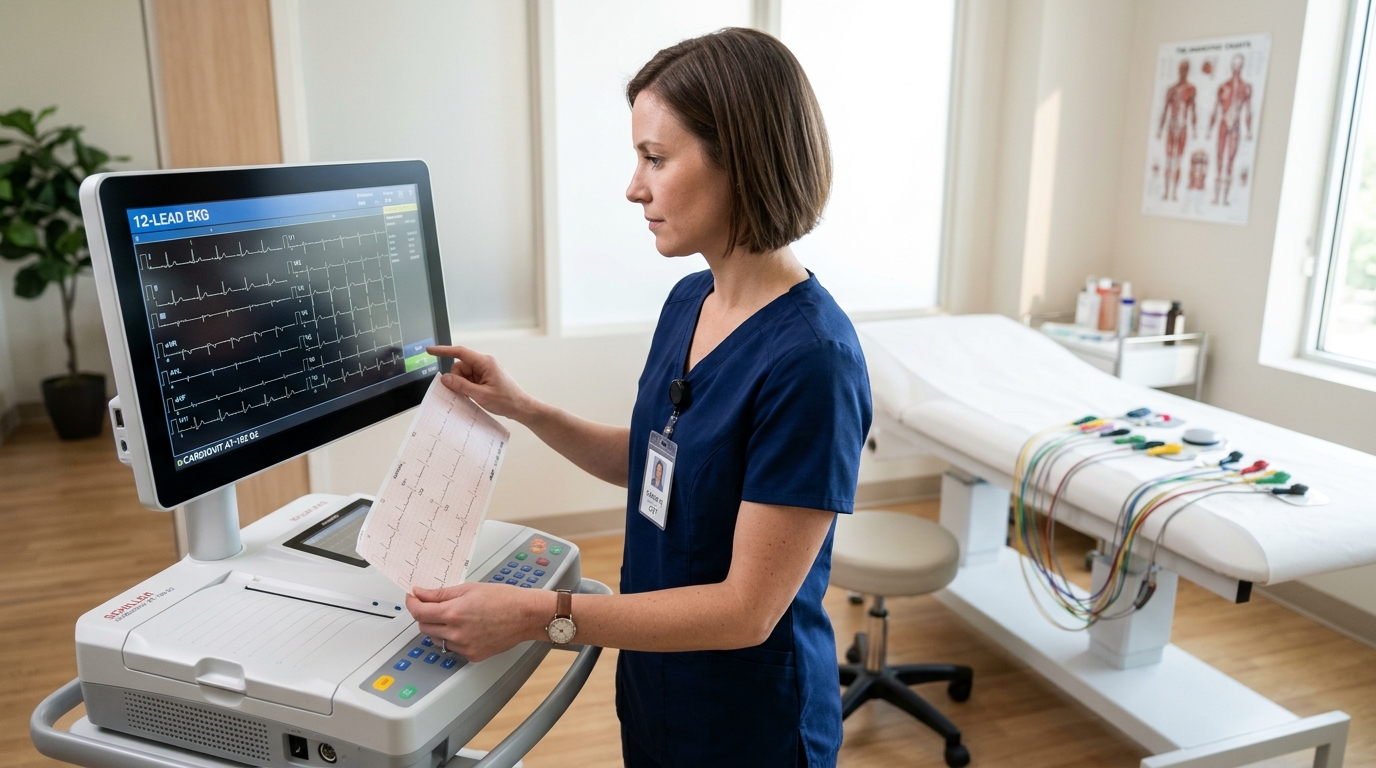
The EKG Technician Certification (CET), awarded by the National Phlebotomy Certification Examination (NPCE), validates clinical, diagnostic, and technical competencies for healthcare professionals operating 12-lead electrocardiographs. Certified EKG technicians expertly prepare patients, position precordial and limb electrodes, troubleshoot waveform artifacts, monitor basic arrhythmias, support Holter monitoring and cardiac stress tests, and assist cardiologists and physicians in detecting vital cardiovascular pathologies.
Program Requirements
Be 18 years of age or older.
High school diploma, GED, college transcript, or foreign country equivalent.
Valid government-issued ID (State ID, driver's license, passport).
Valid Social Security Number (SSN) or current ITIN in the US.
Complete the United States Medical Institute (USMI) enrollment form.
No prior medical or clinical experience required.
Choose Your Study Modality
100% Online
Complete your EKG technician training entirely online at your own pace. Access interactive cardiac lectures, rhythm interpretation modules, digital tracing analysis, and NPCE prep evaluations with 24/7 flexibility.
Hybrid (90/10)
90% of classes are conducted live online via Google Meet or Zoom. The remaining 10% corresponds to supervised in-person electrode placement drills, artifact troubleshooting, and real ECG machine practice at USMI.
100% In-Person
Attend classes at USMI facilities according to your schedule. Practice directly with modern multi-channel ECG machines, Holter monitor setups, and cardiovascular diagnostic protocols under expert instructor guidance.
Program Objectives
The program prepares students to perform diagnostic-quality electrocardiograms safely and with clinical excellence, aligned with NPCE national standards:
- 12-Lead EKG Technical Mastery: Prepare patients, position anatomical limb and precordial chest leads (V1–V6) with precision, and operate diagnostic multi-channel recording machines.
- Artifact Recognition & Troubleshooting: Identify and eliminate common waveform distortions: somatic muscle tremors, alternating current (AC) 60-cycle interference, and wandering baselines.
- Basic Arrhythmia & Critical Rhythm Recognition: Read P waves, QRS complexes, T waves, PR intervals, and recognize sinus rhythms, bradycardias, tachycardias, and life-threatening rhythms requiring immediate escalation.
- Cardiac Diagnostic Testing Support: Master ambulatory Holter monitor placement, patient event logging instructions, and assist clinical teams during treadmill stress tests.
- Safety, Ethics & Patient Privacy: Practice medical asepsis, equipment sanitization, patient dignity preservation, and strict HIPAA confidentiality of clinical cardiovascular records.
Professional Functions
A certified EKG Technician plays an essential role in cardiovascular diagnosis across three operational stages:
- Pre-Procedure Patient Preparation: Verify physician requisitions and two patient identifiers, explain the procedure to alleviate anxiety, position the patient supine, and prep skin surfaces for optimal electrode contact.
- Intra-Procedure Tracing Acquisition: Attach lead cables, calibrate gain and chart speed (standard 25 mm/s, 10 mm/mV), capture clean 12-lead tracings, and monitor patient comfort and vital indicators throughout.
- Post-Procedure Processing & Disinfection: Remove electrodes comfortably, clean and sanitize lead wires and equipment, label rhythm strips with clinical metadata, and transmit files securely to interpreting cardiologists.
What's Included in Your Tuition?
Enrolling at USMI gives you comprehensive diagnostic training and all resources necessary to earn your national EKG technician certification:
Full Course Access
Access all lectures, cardiac anatomy modules, and classes in your selected modality until graduation.
Study Materials
Official digital textbooks, cardiac rhythm calipers, EKG strip reference cards, and Canvas platform access.
Live Practice
Supervised hands-on clinical lab practice: electrode placement, tracing acquisition, and Holter setups.
Exam Voucher
Includes full national examination fee for the EKG Technician Certification exam administered by NPCE.
Certification
Official digital certificate and badge issued in 24–48 hours, plus verifiable national registry status.
Additional Program Details
The curriculum covers the comprehensive cardiovascular, electrophysiological, and technical domains evaluated on the NPCE EKG Technician certification exam:
1. Cardiovascular Anatomy & Electrophysiology
- Heart Structure & Blood Flow: Atria, ventricles, cardiac valves, coronary arteries, and pulmonary circulation.
- Intrinsic Conduction System: Sinoatrial (SA) node, atrioventricular (AV) node, Bundle of His, bundle branches, and Purkinje fibers.
- Cardiology Terminology: Common diagnoses, cardiovascular medications, and standard medical abbreviations.
2. Instrumentation, Leads & Patient Preparation
- Electrode Anatomy & Placement: Accurate anatomical landmarks for 12-lead placements (limb leads RA/LA/RL/LL and precordial leads V1–V6).
- Machine Settings: Calibration, voltage standards (10 mm/mV), and chart speed adjustments (25 mm/s vs. 50 mm/s).
- Skin Preparation: Skin abrasion, hair management, alcohol defatting, and electrode gel adhesion protocols.
3. Waveform Analysis & Artifact Correction
- Wave Components: P wave (atrial depolarization), PR interval, QRS complex (ventricular depolarization), ST segment, and T wave.
- Artifact Mitigation: Differentiating somatic tremor, wandering baseline, and 60-cycle alternating current (AC) interference.
4. Basic Rhythm Recognition & Critical Alerts
- Rhythm Classification: Normal sinus rhythm, sinus bradycardia, sinus tachycardia, sinus arrhythmia, and premature ventricular contractions (PVCs).
- Critical Alert Rhythms: Recognizing ventricular fibrillation (VF), ventricular tachycardia (VT), asystole, and acute ST-elevation (STEMI) requiring immediate provider notification.
5. Ambulatory Monitoring, Stress Testing & Safety
- Holter & Event Monitoring: 24-48 hour lead hookup, patient diary instructions, and telemetry monitoring procedures.
- Exercise Stress Testing: Bruce protocol basics, patient preparation, continuous monitoring, and emergency stop triggers.
- Safety & Compliance: OSHA guidelines, infection control between patients, and HIPAA privacy rules for digital ECG storage.
Step-by-Step Graduation Process
- Complete Enrollment: Submit the USMI enrollment agreement and government-issued identification.
- Coordinate Schedule: Establish your study plan and lab sessions with your assigned instructor according to your chosen modality.
- Complete Academic Training: Complete all theoretical cardiac modules, rhythm analysis assignments, and practical lab sessions.
- Request Certification Clearance: Request exam registration clearance from USMI once course requirements are fulfilled.
- Access Canvas Platform: Receive an official invitation from Canvas Instructure to access NPCE study modules.
- Pass the National Exam: Complete the 120-minute multiple-choice national exam online or at an approved proctored site. Candidates have 2 attempts (a 280-day waiting period applies if both attempts are failed).
- Receive Your Credentials: Official digital certificate and digital badge arrive via email in 24 to 48 hours. Optional physical kits (printed diploma, card, pin) arrive in 7 to 10 days via USPS.
Credentials Awarded
- EKG Technician Certification (CET) – NPCE: Nationally recognized credential validating specialized competence in clinical electrocardiography.
- Digital Certificate & Digital Badge: Secure electronic credentials for mobile verification, LinkedIn profiles, and professional resumes.
- Physical Kit (Optional): Embossed diploma, wallet credential ID card, USMI lanyard, and professional lapel pin.
- 24/7 Online Registry: Public employer credential verification through the official NPCE verification registry.
Certification Maintenance & Renewal
The NPCE EKG Technician certification is valid for 1 or 2 years depending on the initial package selected:
- Continuing Education (CE): Complete 6 CE credits (included with your NPCE renewal purchase).
- Timely Renewal: No re-examination is required if renewed prior to expiration. Digital certificate issued within 24–48 hours.
- Lapsed Credentials: If expired for more than 90 days, the candidate must retake the examination.
Core Graduate Capabilities
- Diagnostic Tracing Precision: Obtain clean, readable, artifact-free 12-lead electrocardiograms on diverse adult and pediatric patients.
- Electrode Accuracy: Flawless landmarking of precordial leads (V1–V6) to prevent diagnostic misreadings of bundle branch blocks or infarcts.
- Critical Awareness: Immediately distinguish benign rhythm variations from acute life-threatening cardiac dysrhythmias.
- Compassionate Care: Put anxious, cardiac-symptomatic patients at ease with calm, professional, and empathetic bedside manners.
Hard & Soft Professional Skills
- Technical Skills (Hard Skills): 12-lead ECG machine operation, Holter monitor hookup, caliper measurement of cardiac intervals, skin prep, and electronic EHR chart integration.
- Service Skills (Soft Skills): Clear communication, active listening, gentle patient reassurance, and interdisciplinary collaboration with nurses and cardiologists.
- Critical Response Skills: Immediate recognition of ventricular fibrillation (VF), acute chest pain escalation, and basic life support protocol activation.
Why Certify with NPCE?
- Nationally Verifiable Credential: Verified online 24/7, providing hospitals, cardiology practices, and urgent cares nationwide confidence in your expertise.
- Competitive Healthcare Advantage: Distinguish your clinical resume by proving verified national mastery in 12-lead electrocardiography.
- Focused Specialty Track: Ideal gateway for entering healthcare directly with a focus on cardiology and cardiovascular medicine.
- Fast Digital Credentialing: Digital certificate and badge issued within 24–48 hours following exam completion.
- Stackable Healthcare Pathway: Seamlessly pair with NPCE Phlebotomy (CPT) or Clinical Medical Assistant (CMA) credentials to maximize clinical employability.
Labor Opportunities
- Hospitals & Medical Centers: Inpatient cardiology units, emergency departments, and cardiac catheterization recovery suites.
- Cardiology & Specialty Practices: Outpatient routine exams, pre-operative clearances, and chronic disease follow-ups.
- Telemetry & Central Monitoring Units: Continuous telemetry rhythm surveillance for high-acuity patients.
- Cardiac Rehabilitation Centers: Monitored exercise ECG testing for post-operative cardiac patients.
- Mobile & Insurance Exam Companies: Portable ECG screenings for life insurance underwriting.
Cardiovascular Healthcare Outlook
According to the U.S. Bureau of Labor Statistics (BLS), cardiovascular technologists and technicians work in dynamic healthcare environments where certified technicians remain in steady, essential demand across outpatient clinics and hospital telemetry departments.
Clinical Simulation & Scope Policy
Hands-on clinical training takes place within USMI’s instructional laboratories utilizing modern multi-channel ECG machines, electrode lead sets, and supervised live simulations. The curriculum does not include mandatory hospital externships; USMI actively guides students on how to independently apply for EKG technician and telemetry positions across regional healthcare networks.
State Regulations & Regulatory Standards
Regulations governing EKG technicians vary by state and healthcare facility:
- Licensing: Most states do not require a separate state license for EKG technicians; hiring facilities establish national certification and BLS requirements as hiring standards.
- Combined Roles: If an EKG technician also performs venipuncture (phlebotomy), state-specific phlebotomy licensing laws apply (such as California, Nevada, Washington, and Louisiana).
- Federal Standards: Full compliance with OSHA workplace safety mandates and HIPAA patient health data confidentiality regulations is mandatory nationwide.
Institutional Information
United States Medical Institute (USMI) is a 100% private educational institution. We do not participate in federal Title IV financial aid, public grants, or government-funded student loan programs. All tuition is financed directly through our institution’s flexible payment plans.
Official Contact Channels:
- Phone / WhatsApp: +1 (346) 855-4600
- Email: info@unitedstatesmedicalinstitute.com
- Address: 396 W. Greens Rd, 7th Floor, Suite 786, Houston, TX 77060
- Website: unitedstatesmedicalinstitute.com
Which Agency Issues the Certification?
Upon successful completion of theoretical training, practical electrocardiography simulations, and internal evaluations at United States Medical Institute (USMI), the certification is issued by:
NATIONAL PHLEBOTOMY CERTIFICATION EXAMINATION (NPCE)
Exam Specifications
- Credential: EKG Technician Certification (CET)
- Format: Multiple-Choice Examination
- Time Allotted: 120 Minutes (2 Hours)
- Available Modalities: Online or at an approved USMI proctored facility
- Study Platform: Canvas Instructure access included
- Attempts Allowed: 2 attempts included (280-day waiting period if both attempts are failed)
- Cost: National examination voucher included in your USMI tuition
Accreditation & Reciprocity
Assessed Competencies:
Cardiovascular Anatomy & Electrophysiology, 12-Lead EKG Lead Placement, Artifact Troubleshooting, Waveform Analysis, Arrhythmia Identification, Holter Monitoring, and Patient Safety.
Institutional Standing & Reciprocity:
NPCE is an organizational member of the Institute for Credentialing Excellence (ICE). Reciprocity pathways are available for qualified healthcare professionals. Learn More at NPCE Official Portal.
Investment Plans
Option 1: Pay in FullEconomic Profile (Base)850.00
- Total Investment:
$850.00 - Payment 1 (Today):
$850.00 - Frequency:
Single Payment - Fee 3.3%:
N/A (Cash or Zelle)
Option 3: Weekly PlanFinanced Profile (+20%)1,020.00
- Total Investment:
$1,020.00 - Payment 1 (Today):
$340.00 (Registration) - Frequency:
3 weekly payments of $340.00 (3 Weeks) - Fee 3.3%:
Included
Additional Information
If you would like more information about cardiovascular technologies and EKG technician careers, please visit the Bureau of Labor Statistics (BLS) or the Occupational Information Network (O*NET):